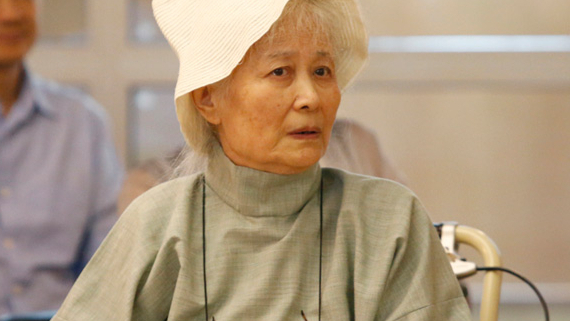
Pang Tao
Introduction
Pang Tao is a prominent Chinese oil painter known for her contributions to the modernization of Chinese art over the past four decades. Born into a family of distinguished artists, she has successfully continued and expanded upon her family's artistic legacy while forging her own distinct path in the art world. Her work is characterized by an innovative blending of cultural traditions and modern art, and she has developed a unique artistic vocabulary that has influenced contemporary Chinese art.
Early Life and Education
Pang Tao was born into an illustrious artistic family, which played a significant role in shaping her artistic inclinations from a young age. Her father, Pang Xunqin, was a renowned painter and graphic designer who co-founded the Central Academy of Arts and Design, which later became part of Tsinghua University's arts and design department. Her mother, Qiu Di, was among China's first generation of female oil painters, having studied in Japan in the early 20th century. Pang Tao's early exposure to art came naturally, and her talent was evident from a young age. At just four years old, she won a prize at a national children's painting competition, and by the age of 13, she held her first exhibition alongside her younger brother, Pang Jun, in Guangzhou. The following year, they exhibited their works again in Shanghai, showcasing the early promise of her artistic career.
Pang Tao's formal art education began at the prestigious Central Academy of Fine Arts in Beijing, where she graduated in the 1950s. This institution played a crucial role in her development as an artist, providing her with a foundation in both traditional and contemporary art forms. Her education was further enriched by her father's innovative spirit, which encouraged her to incorporate cultural traditions into modern art, thereby developing her distinct artistic style. Her father's influence was also evident in her early exposure to Western art, as he had studied at the Academie de la Grande Chaumiere in Paris, a school known for promoting independent thinking and creative freedom.
Career
Pang Tao's artistic career officially began after her graduation from the Central Academy of Fine Arts, where she took on a teaching position until her retirement in 1989. Despite the academic expectations, she always remained committed to her artistic pursuits, continually exploring new styles and techniques. However, as China began its reform and opening-up in 1978, she embraced the opportunity to experiment with contemporary approaches, particularly abstraction.
Artistic Style and Influences
Pang Tao's artistic style is a harmonious blend of abstraction and cultural heritage. Her parents instilled in her the importance of innovation and change, which is evident in her work. Her attempts at abstraction began in earnest in the 1980s, coinciding with a broader shift in Chinese art circles towards contemporary styles. Her reinterpretations of natural landscapes, for instance, demonstrate a departure from traditional realism, offering viewers imaginative experiences. A notable example is her depiction of Xiangbi Mountain in Guilin, where she emphasized the geometric structure and texture of the landscape rather than its realistic details.
Music also plays a significant role in Pang Tao's artistic process. Inspired by her father's love for Johann Sebastian Bach's compositions, she draws parallels between abstract art and music. In her work, she likens the arrangement of shapes, lines, and colors to musical notes and rhythms, creating a dynamic and harmonious visual experience. Her works are often described as "post-abstract," as she seeks to enliven her cultural heritage rather than simply emulate Western models.
Major Exhibitions
Throughout her career, Pang Tao has participated in numerous exhibitions that have showcased the evolution of her artistic style. One of the most notable exhibitions is Dancing Notes at Beijing's Inside-Out Art Museum, which offers a comprehensive view of her work from the 1940s to recent years. This exhibition highlights her individual progress in painting as well as the broader changes in artistic orientation in China. Works from her Revelation of Bronze series are on display, where she uses vibrant colors to bring a rhythmic touch to ancient Chinese cultural elements, such as bronze ware patterns from the Shang and Zhou dynasties.








